
Capital markets for the frontier economy
Trading, credit and capital allocation infrastructure to give emerging assets a path from issuance to scale
Get in touchPowered by


Announcing Formation
Orca and Loopscale merge to build the capital formation and allocation network of the frontier economy, powered by tokenization and onchain finance.
Today we're announcing the merger of Orca and Loopscale. The combined team will operate as Formation, headquartered in New York City and led by Loopscale co-founder Luke Truitt as CEO, with Mary Gooneratne as Chief Operating Officer and Christopher Montagano as Chief Strategy & Legal Officer.
Formation brings Orca's trading and liquidity infrastructure together with Loopscale's credit and vault infrastructure. Built on both protocols, Formation gives issuers a unified path from issuance to scale and allocators a single venue to access those assets and the strategies built around them. We are already working with Figure, Shinhan Asset Management, Superstate, R3, and Securitize to bring new high-quality assets to market and expand their distribution.
The merger does not change how users access or use Orca and Loopscale today. Both applications will continue operating as before, with all existing positions, loans, and vault deposits unaffected. Together, the Orca and Loopscale protocols will form the foundation of the Formation platform and the ORCA and xORCA token network. For more details, see the FAQs in the Orca and Loopscale docs.
Full-stack DeFi for tokenized assets
Tokenization provides a composable record of asset ownership, but asset adoption requires liquid markets, access to credit, and sustained distribution. Today, issuers assemble these capabilities across separate counterparties, each requiring its own diligence process, technical integration, and commercial agreement. Formation integrates liquidity, credit, and vaults into one platform, giving issuers a single team to work with across all three.
Liquidity: Orca provides infrastructure for secondary trading, with market structures suited to different assets. Whirlpools let investors trade against liquidity supplied by LPs, while Riptide lets professional market makers run their own AMM strategies. Permissioned pools support trading among approved participants.
Credit: Loopscale matches borrowers and lenders through an order book, enabling fixed-rate loans with lender-defined, asset-specific terms. That architecture supports bespoke lending products and complex collateral, including fully permissioned assets and novel DeFi assets such as Orca LP positions.
Vaults: Loopscale Earn Vaults and Loopscale Asset Curation power Formation’s distribution capabilities. Earn Vaults offer allocators access to strategies across multiple venues that span yield, credit, and market-making. The curation team structures these strategies and connects issuers with the liquidity providers and participants needed to scale their assets.
This infrastructure already operates at a meaningful scale. Orca has processed more than $550 billion in trading volume since 2021, while Loopscale has facilitated more than $2 billion in loans and currently holds over $150 million in deposits.
When deeply integrated, liquidity, credit, and vaults create a reinforcing cycle that attracts capital and sustains asset demand. Deeper liquidity helps investors enter and exit positions and makes an asset more useful as collateral. Credit and Loops create new reasons to hold the asset and generate trading activity. Vaults direct allocator capital into both markets, expanding their capacity and supporting the asset’s growth.
Shrinking the minimum viable asset
AI, energy, robotics, and defense are creating new businesses and assets whose financing needs are outpacing traditional market infrastructure. Apollo estimates that AI infrastructure alone will require nearly $3 trillion through 2028, with more than half coming from external capital.
Many of these financing needs fall outside the scale and structures capital markets efficiently serve. A $5 million financing can require much of the same underwriting, legal, servicing, and distribution infrastructure as a $50 million deal. Those fixed costs establish what our team calls the “minimum viable asset”: the smallest issuance that is economically viable to bring to market.
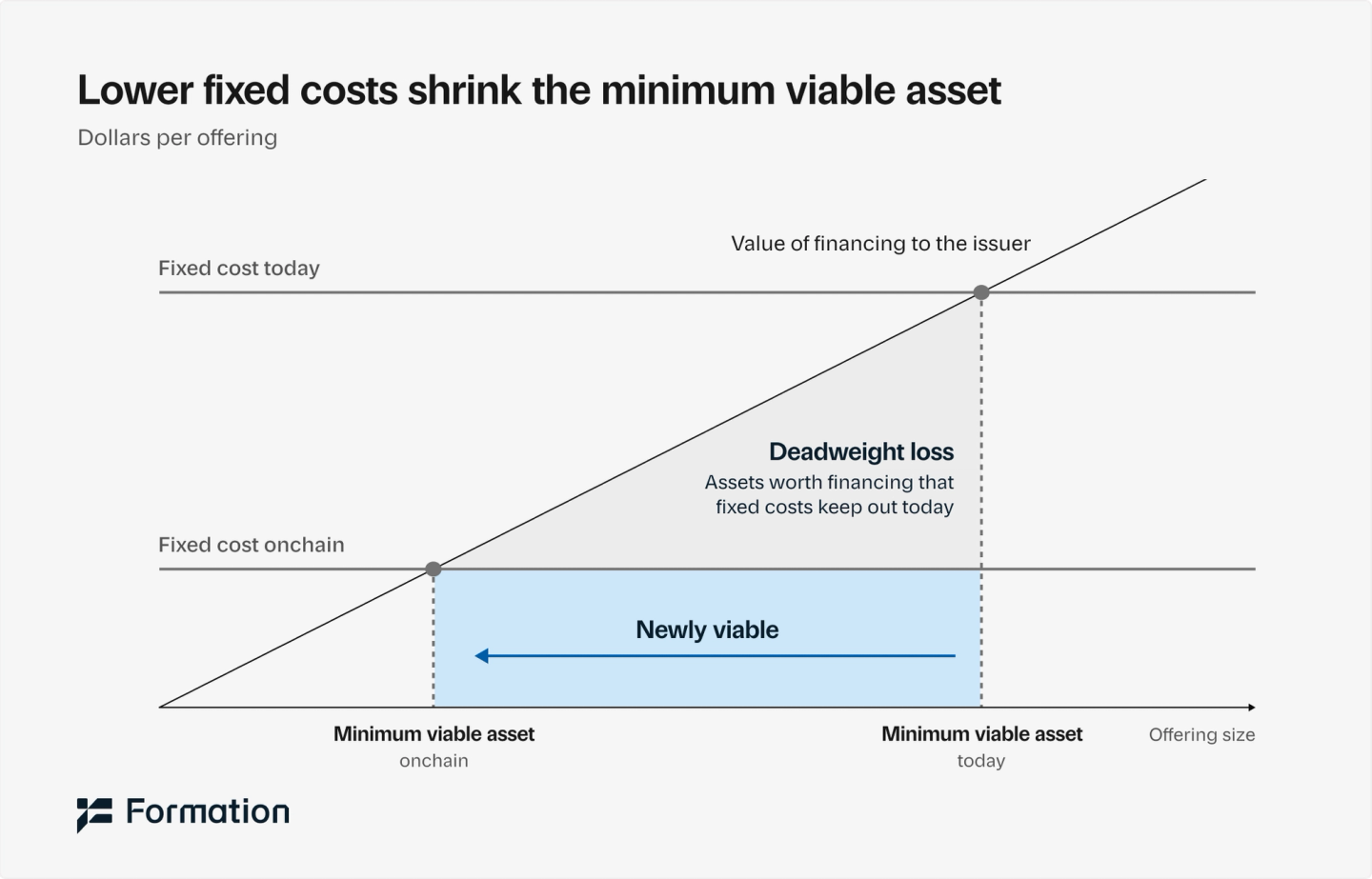
Financial innovation has repeatedly served as a prerequisite for new industries to scale, from corporate bonds financing railroads to mortgage-backed securities expanding housing finance. We believe tokenization and DeFi will drive the next such expansion. Programmable markets and reusable infrastructure reduce the cost of creating, distributing, and financing each new asset, lowering the minimum viable asset threshold. Our full-stack approach extends these capabilities across the entire asset lifecycle to realize the transformative opportunity of onchain finance, making new financial products, and the businesses they fund, economically viable.
Issuers are already demonstrating what this infrastructure enables by building markets around assets such as reinsurance and telecom debt. OnRe has grown its reinsurance fund past $250 million, with onchain credit and yield markets helping bring its cost of capital below 7%. DAWN Technologies launched a telecom debt product on our stack in under 30 days, with trading and credit live from day one and more than $10 million deposited in the first 24 hours. Figure has grown two assets to nine-figure AUM through DeFi credit and secondary markets at a lower cost of capital than its traditional alternatives.
American DeFi for a global financial system
On September 17, the SEC issued its innovation exemption, establishing a five-year framework to enable the onchain trading of U.S.-listed stocks through what it calls tokenized securities venues. This creates a concrete path forward for DeFi infrastructure to serve American capital markets, a convergence Formation has been building toward through Orca’s nearly two years of engagement with securities and commodities regulators.
Formed by two U.S.-built companies and headquartered in New York, Formation reflects our conviction that the United States will remain the center of global finance as markets move onchain. We plan to operate a tokenized securities venue under this framework and pursue the licenses needed to expand our offerings, connecting American issuers with global capital and American investors with tokenized global assets.
Looking ahead
Formation is building across origination, issuance, liquidity, credit and distribution, with a path into regulated U.S. capital markets. This work spans:
- Issuer and originator tools to support the creation of new financial products and help institutions bring existing offerings onchain
- Capital allocation strategies and integrations that give allocators broader access to tokenized assets and the investment opportunities built around them.
- Advances in core protocol infrastructure that expand the capabilities of credit, market making, and vault management.
- New assets across fixed income, equities, and other markets that also enable new vault strategies, trading markets, and lending products.
Realizing this opportunity requires depth in financial structuring, asset curation, issuer relationships, distribution, and regulatory expertise. We’re bringing those capabilities together in-house to build a global engine of capital formation on Orca and Loopscale, driving more assets, capital, and financial activity through both protocols. Our ambition is for onchain finance to expand beyond serving existing markets and finance the emergence of new industries and the innovations that define them.
For issuers, Formation provides a path to launch and scale assets onchain. For allocators, an initial set of products is available on Orca and Loopscale today. Learn more at formation.so and follow @formation_so on X.